
How Confusing Websites Create Invisible Revenue Leaks
Chapter 5 - Why Traditional Analytics Often Miss UX Revenue Leaks
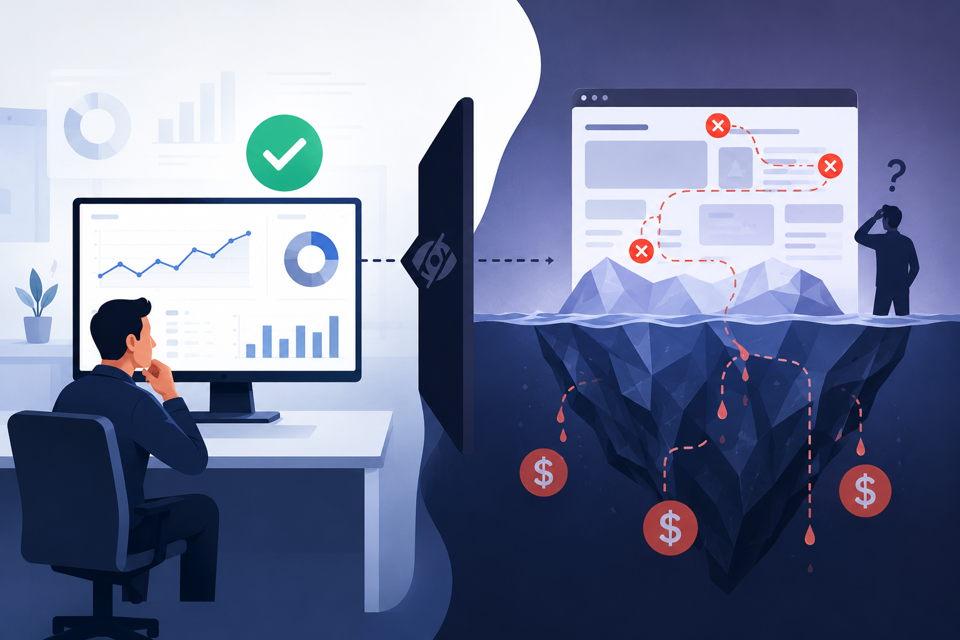 Analytics platforms are excellent at measuring outcomes. They are significantly weaker at measuring hesitation.
This distinction explains why many companies struggle to diagnose website conversion problems accurately.
Metrics Show What Happened, Not Why
A dashboard can show abandonment, but it cannot always show uncertainty. That distinction matters because hesitation patterns often appear weeks before measurable conversion decline.
A dashboard may reveal high bounce rates, low demo conversions, weak onboarding completion, cart abandonment, and session drop-offs. However, what it rarely reveals clearly is the psychological sequence behind those outcomes.
For example, did users leave because pricing felt expensive, or because the website failed to establish trust before pricing appeared? Those are very different business problems.
Behavioral Analysis Reveals Friction Earlier
High-performing product and growth teams increasingly combine analytics with behavioral UX analysis, including heatmaps, session recordings, scroll tracking, rage click analysis, cursor hesitation analysis, and funnel replay observation.
For instance, a SaaS company may discover that users repeatedly revisit pricing pages before abandoning. In many cases, the issue is not pricing itself; instead, it is unclear value communication before pricing evaluation occurs. That distinction changes the optimization strategy entirely.
Not every conversion issue originates from UX, as traffic quality, market positioning, pricing, and product-market fit still matter enormously.
However, many companies attempt to solve conversion inefficiency exclusively through acquisition optimization while ignoring decision friction already present on-site, and that approach usually compounds waste.
Analytics lag behind psychology.
By the time conversion metrics collapse visibly, hesitation patterns have often existed for months. That delay compounds quietly into wasted acquisition spend.