
Bundelkhand's Ken-Betwa Protests Are a Verdict on How India Builds
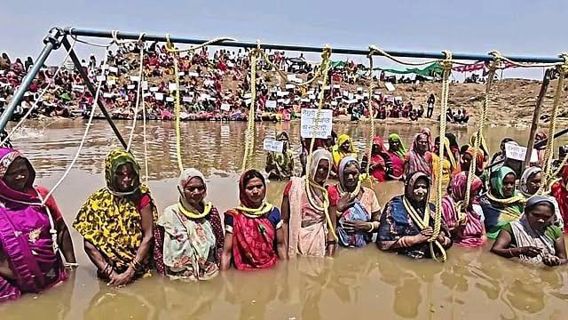
On the banks of the Ken river in Chhatarpur district, hundreds of women have, over the past several months, lain down on mock funeral pyres, faces smeared with river mud. Others have waded into the water with ropes knotted around their necks, or buried themselves waist-deep as a symbolic burial of the living. These are not isolated acts of despair. They are organised, named forms of protest — the Chita Andolan, the Jal Andolan, the Mitti Andolan — devised by a peasantry that has run out of ordinary channels to be heard. What began as scattered resistance around the village of Daudhan has, through 2026, grown into one of the most sustained rural mobilisations Bundelkhand has seen in years, aimed squarely at the Ken-Betwa Link Project, the country's first river interlinking scheme.
The project's promise is seductive on paper: a 221-km canal fed by the Daudhan dam to carry what planners call "surplus" water from the Ken basin into the drier Betwa basin, irrigating over a million hectares and supplying drinking water to more than six million people across fourteen drought-scarred districts of Madhya Pradesh and Uttar Pradesh. For a region whose name has become a byword for agrarian ruin — failed monsoons, groundwater collapse, farmer suicides, distress migration to the brick kilns of Punjab and the construction sites of Delhi — such a promise carries real emotional weight. That is precisely why the manner of its execution matters so much, and why its betrayal cuts so deep.
The dam site itself sits inside the core of the Panna Tiger Reserve, and the numbers involved are difficult to hold in the mind at once: several thousand hectares of prime tiger habitat submerged, well over two million trees felled, a wildlife corridor severed, and roughly seven thousand families across some twenty villages in Chhatarpur and Panna districts facing eviction from land their families have worked for generations. As early as 2019, the Supreme Court's own Central Empowered Committee had questioned the project's basic premise, noting that the ecological costs of species recovery and forest loss, if honestly counted, could render the scheme economically unviable. This year, the Court went further, reminding the government that environmental governance in India must be eco-centric rather than anthropocentric, and that the claims of forest-dwelling communities cannot be an afterthought to be settled once the bulldozers have already arrived.
They arrived anyway. Since April, when the first sustained twelve-day protest was called off only after the district administration promised a fresh, transparent survey within ten days, the pattern on the ground has been depressingly familiar: assurances offered to defuse an agitation, followed by demolitions resuming — during the monsoon, in several documented instances — before the promised redress had been delivered. Section 163 of the new criminal procedure code, restricting assembly, has reportedly been invoked at the project site, even as villagers in places like Imalha have had to physically stand in their own fields to stop survey teams from working. Compensation, when it does arrive, has varied wildly and often arbitrarily between neighbouring households, fuelling allegations of corruption in the survey process itself; several affected families report receiving far below prevailing land rates, while activists have separately flagged a gender gap in how payouts are recorded and disbursed. Only this month, the state government sweetened its rehabilitation package to try and end the deadlock. Protesters have refused it, insisting — as one local organiser has put it — that this was never only about money, but about land, dignity, and a process that treats them as citizens rather than obstacles.
It would be a mistake to read this as a story only about one dam. My own research into agrarian distress in Bundelkhand has tried to trace how such episodes are embedded in a longer social architecture — one in which the state's response to drought has historically been infrastructural and top-down (a canal, a dam, a pipeline) rather than an engagement with the region's underlying land relations, caste hierarchies, and the precarious tenancy arrangements that determine who actually captures the benefit of any water that does arrive. Bundelkhand's water crisis has never been purely meteorological; it is compounded by fragmented and heavily indebted small landholdings, the erosion of traditional water-harvesting structures like chandelas and talabs, and a rural economy where even a good monsoon often cannot reverse a decade of accumulated debt. A project imposed through displacement notices and police cordons, without functioning gram sabha consultations, does not interrupt this architecture of distress. It reproduces it in a new form — this time with the added violence of dispossession from ancestral land.
There is also a quieter irony worth sitting with. Experts studying the Ken and Betwa basins have long pointed out that the two rivers share broadly similar rainfall and drought patterns, undercutting the very notion of a clean transfer from a "surplus" to a "deficit" basin. If that critique holds, then the human and ecological price being paid in Daudhan and Palkoha is being extracted for a hydrological premise that may not survive scrutiny.
None of this is an argument against addressing Bundelkhand's water crisis, which is real and urgent. It is an argument for how such projects must be built: with rehabilitation settled before displacement, not after; with compensation benchmarked transparently to prevailing land values; with gram sabhas whose consent is sought rather than presumed; and with the ecological findings of the state's own expert committees treated as binding, not decorative. What the pyres on the Ken riverbank are ultimately protesting is not development itself, but a familiar Indian pattern in which the poorest are asked, once again, to absorb the costs of a promise made in their name but rarely kept on their terms.
Follow Aniket Rathour to stay updated on their latest posts!
0 comments
Be the first to comment!
This post is waiting for your feedback.
Share your thoughts and join the conversation.