
Understanding Reactive Diluents in UV Curable Coatings: Functions, Benefits, and Applications
Introduction
The coating industry is continuously evolving with the development of advanced technologies that provide improved durability, faster processing, and enhanced environmental performance. Among these technologies, UV-curable coatings have become an important solution for industries requiring high-performance surface protection with reduced curing time and lower solvent emissions.
UV-curable coating formulations consist of several key components, including oligomers, photoinitiators, pigments, and reactive diluents. Reactive diluents play a critical role in controlling formulation viscosity while also contributing to the final properties of the cured coating.
Among various reactive diluents used in UV formulations, multifunctional acrylate monomers such as Trimethylolpropane Triacrylate (TMPTA) are widely preferred due to their excellent reactivity and crosslinking performance.
What Are Reactive Diluents in UV Coating Systems?
Reactive diluents are low-viscosity chemical compounds that are added to UV-curable coating formulations to reduce viscosity and improve processing characteristics. Unlike traditional solvents, reactive diluents participate in the polymerization process and become part of the final polymer network.
They help manufacturers achieve:
Better coating flow and application properties
Faster curing performance
Improved mechanical strength
Enhanced surface properties
Reduced dependence on volatile solvents
Reactive diluents are commonly used in coatings, adhesives, printing inks, and other radiation-curable applications.
Importance of Multifunctional Acrylate Monomers in UV Coatings
Acrylate monomers are essential building blocks in UV-curable systems because they contain reactive double bonds that allow rapid polymerization under UV radiation.
Multifunctional acrylate monomers contain multiple reactive groups, which increase crosslink density and improve coating performance.
The major advantages include:
Enhanced Crosslinking Ability
Multifunctional monomers create a three-dimensional polymer structure during curing. This improves coating hardness, chemical resistance, and durability.
Improved Mechanical Properties
The use of multifunctional acrylates enhances resistance against abrasion, scratches, and external environmental conditions.
Faster Processing
Higher reactivity allows coatings to cure quickly, helping manufacturers improve production efficiency and reduce processing time.
Role of Trimethylolpropane Triacrylate (TMPTA) as a Reactive Diluents
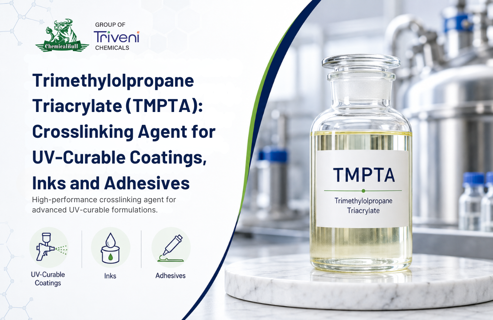
Trimethylolpropane Triacrylate (TMPTA) is a trifunctional acrylate monomer commonly used in UV-curable formulations. Due to its three acrylate functional groups, it provides excellent crosslinking capability and improves the overall performance of cured coatings.
TMPTA is used in various applications including:
UV protective coatings
Printing inks
Industrial coatings
Adhesive formulations
Electronic coatings
For detailed information about TMPTA properties, applications, and industrial uses, explore this comprehensive article on Trimethylolpropane Triacrylate for adhesives.
Applications of Reactive Diluents in Different Industries
1. Printing Ink Industry
UV-curable printing inks require fast curing, excellent adhesion, and high durability. Reactive diluents help improve ink performance by enhancing viscosity control and curing efficiency.
TMPTA-based formulations are commonly used to improve print quality, surface hardness, and resistance properties.
2. Adhesive Manufacturing
UV-curable adhesives require strong bonding performance and fast curing characteristics. Reactive diluents improve formulation flexibility and mechanical strength.
They are used in applications such as electronics assembly, optical bonding, and industrial adhesive systems.
3. Protective Coatings
Industrial surfaces require coatings that can withstand chemicals, moisture, abrasion, and mechanical stress. Reactive diluents help develop durable protective coatings with improved performance.
4. Electronics and Plastic Coatings
Electronic components and plastic materials require protective coatings with excellent adhesion and resistance properties. UV-curable systems containing multifunctional acrylates provide efficient surface protection.
Benefits of UV Curable Coatings Using Reactive Diluents
The increasing demand for UV-curable coatings is driven by several advantages:
Low VOC Emissions
Unlike solvent-based coatings, UV-curable systems produce minimal volatile organic compound emissions, supporting environmentally friendly manufacturing.
Energy Efficiency
UV curing requires less energy compared with conventional thermal curing methods, making it suitable for modern production environments.
Excellent Surface Performance
UV coatings provide excellent gloss, hardness, chemical resistance, and durability.
Faster Production Cycles
Rapid curing allows manufacturers to increase productivity and reduce manufacturing time.
Factors to Consider When Selecting Reactive Diluents
Selecting the right reactive diluent depends on the desired coating performance and application requirements.
Important factors include:
Reactivity level
Viscosity reduction capability
Compatibility with oligomers
Flexibility requirements
Final coating hardness
Chemical resistance requirements
Multifunctional reactive diluents like TMPTA are selected when higher crosslinking performance and durability are required.
Future Development of UV Coating Technologies
The demand for sustainable and high-performance coatings continues to increase across industries. Future innovations are expected to focus on:
Bio-based reactive diluents
Low-energy curing technologies
Improved UV coating formulations
Sustainable printing solutions
Advanced adhesive systems
As coating manufacturers continue to improve formulation performance, multifunctional acrylate monomers will remain important components in next-generation UV curing technologies.
Conclusion
Reactive diluents are essential components of UV-curable coating systems, providing viscosity control, improved curing performance, and enhanced coating properties. Among available multifunctional acrylate monomers, Trimethylolpropane Triacrylate (TMPTA) plays a significant role due to its excellent crosslinking ability and versatility.
From industrial coatings and printing inks to adhesives and electronic applications, TMPTA-based formulations help manufacturers achieve durable, efficient, and high-performance coating solutions.
0 comments
Be the first to comment!
This post is waiting for your feedback.
Share your thoughts and join the conversation.