
How Confusing Websites Create Invisible Revenue Leaks
Chapter 7 - How to Identify Revenue Leaks on Your Own Website
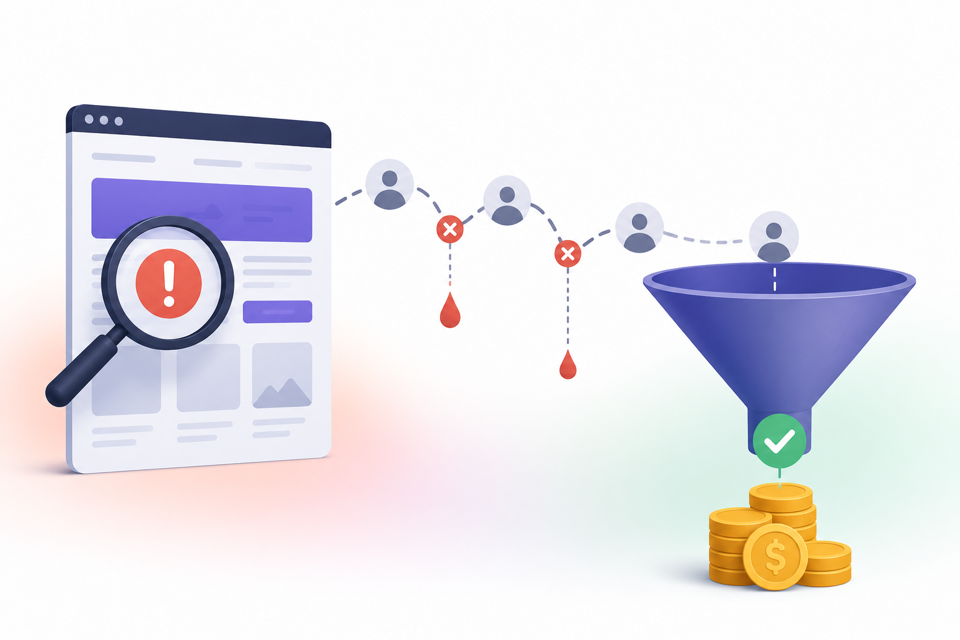
Most companies underestimate the severity of friction because internal familiarity distorts perception. Teams already understand the product, but first-time visitors do not. That is why structured diagnostic reviews matter.
Run the 5-Second Clarity Test
Ask a new visitor to answer these questions after viewing your homepage for five seconds:
What does this company do?
Who is it for?
What problem does it solve?
What should you do next?
If answers vary significantly, clarity problems likely exist.
Every page should communicate a primary action, while secondary actions may support exploration without competing aggressively with the core conversion goal.
When everything demands attention simultaneously, users delay decisions.
Analyze Messaging Comprehension
Look for excessive jargon, abstract positioning, generic claims, feature-first explanations, and long paragraphs without hierarchy
Clarity should reduce interpretation effort, not increase it.
Study Funnel Hesitation Patterns
Behavioral tools often reveal friction that remains invisible in standard analytics. Watch for repeated page revisits, scroll stalls, rage clicks, cursor hovering, form abandonment pauses, and pricing hesitation loops, as these are signs of uncertainty rather than random behavior.
1. Messaging Clarity
Question: Can users explain your value in seconds?
Risk: Weak demo intent and lower conversion momentum.
2. CTA Structure
Question: Is there one clear next step?
Risk: User hesitation during decision-making.
3. Navigation
Question: Can visitors quickly find what matters to them?
Risk: Funnel abandonment before engagement.
4. Onboarding
Question: Are users guided immediately after entry?
Risk: Activation drop-off and slower adoption.
5. Trust Signals
Question: Does the experience feel credible and proven?
Risk: Increased sales friction.
6. UX Consistency
Question: Are interactions intuitive and predictable?
Risk: Reduced confidence in the product.
If several of these friction signals appear simultaneously, the issue is likely systemic rather than cosmetic. That is typically the point where a UX audit becomes commercially necessary.