
How Confusing Websites Create Invisible Revenue Leaks
Chapter 3 - Why Confusing UX Hurts Revenue More Than Most Teams Realize
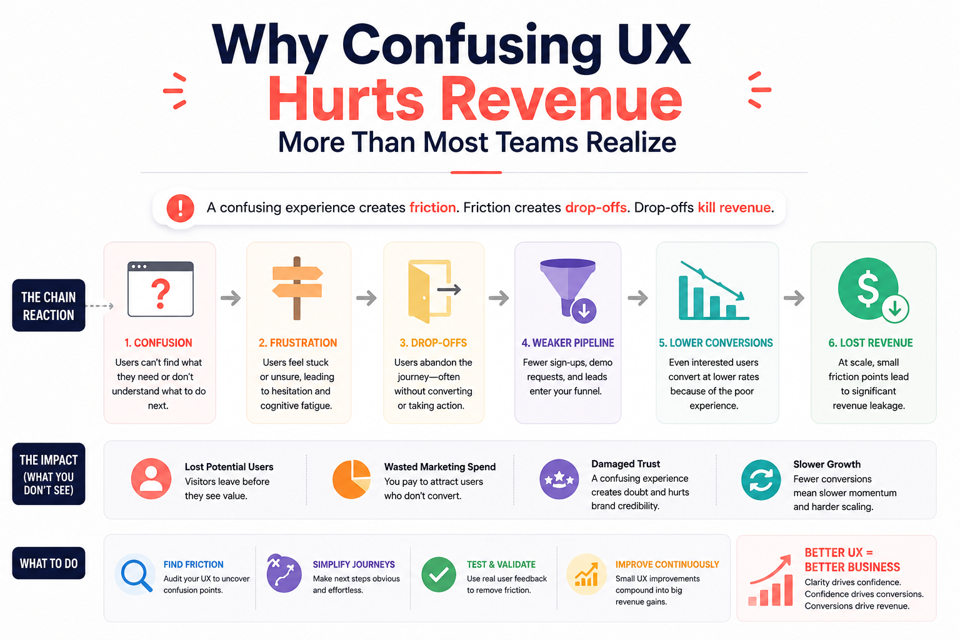
Most growth teams underestimate how directly UX confusion affects acquisition economics. The assumption is usually this:
“If traffic is growing, the funnel is fundamentally healthy.”
That assumption breaks quickly when conversion efficiency starts declining. A confusing website losing customers does not only reduce conversions. It increases the cost of every future acquisition effort.
CAC Inflation Starts With Friction
Research from the Nielsen Norman Group has repeatedly shown that users leave interfaces when comprehension effort becomes too high, especially during complex decision-making journeys. In B2B funnels, that effort translates directly into wasted acquisition spend because users abandon before understanding differentiated value.
This is where the Interpretation Tax™ becomes commercially dangerous.
Every additional moment users spend decoding positioning, comparing unclear actions, or interpreting navigation structure increases acquisition inefficiency.
When users fail to understand value quickly, businesses compensate elsewhere through higher ad spend, more retargeting, longer nurture sequences, more aggressive sales involvement and additional onboarding support.
In other words, poor clarity creates operational drag. A fintech platform with compliance-heavy onboarding flows may attract strong acquisition traffic through paid campaigns, but if users encounter dense forms, unclear requirements, or overwhelming setup instructions too early, abandonment rises.
Marketing may interpret this as a traffic quality issue, sales may see it as weak buyer intent, and product teams may blame onboarding complexity. However, the real issue is often cognitive overload.
Trust Erosion Happens Faster Than Teams Expect
B2B buyers make fast trust judgments, especially in AI and fintech categories where skepticism already exists. If messaging feels vague, navigation feels inconsistent, or hierarchy feels cluttered, users subconsciously associate that confusion with operational risk.
This is particularly dangerous for enterprise SaaS platforms, financial products, infrastructure tools, and AI systems handling sensitive workflows.
Users rarely separate product trust from interface trust.
A confusing experience creates doubt about the company itself, even when the underlying product is strong. That doubt slows decision-making, and slower decisions increase acquisition inefficiency.
The Revenue Impact Most Dashboards Miss
Many teams track direct conversion metrics while ignoring hesitation indicators, even though hesitation often predicts revenue decline earlier than raw conversion numbers.
Examples include users revisiting the homepage repeatedly, high scroll depth with low CTA engagement, navigation loops between pricing and features, long inactive pauses during onboarding, and session replays showing repeated cursor hesitation.
These patterns signal friction before funnel collapse becomes obvious. That is why companies experiencing rising CAC despite stable traffic should investigate UX clarity before scaling acquisition further, because scaling confusion simply accelerates waste.