
Breaking Down IoT: Sensors, Connectivity, Data Processing, and Applications
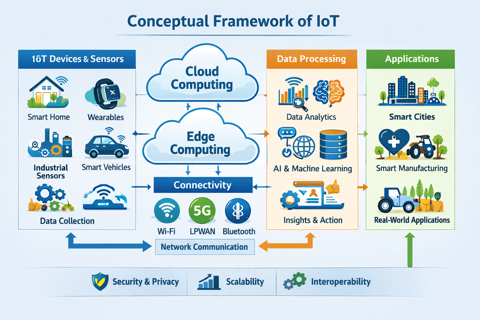
The Internet of Things (IoT) has transformed how devices interact, communicate, and deliver value in the digital age. From smart homes to industrial automation, IoT systems are built on a structured ecosystem that enables seamless data exchange and intelligent decision-making.
To fully understand how IoT works, it’s essential to explore its four core building blocks: sensors, connectivity, data processing, and applications.
Sensors: The Data Collectors
Sensors are the foundation of any IoT system. They are responsible for collecting data from the physical environment and converting it into digital signals that machines can understand.
These devices can measure a wide range of parameters, including:
Temperature
Humidity
Motion
Light intensity
Pressure
For example, in a smart home, temperature sensors monitor room conditions, while motion sensors detect activity. In industrial settings, sensors track machine performance and environmental factors.
Without sensors, IoT systems would have no data to analyze, making them the starting point of the entire ecosystem.
Connectivity: The Communication Bridge
Once data is collected, it needs to be transmitted to other devices or systems for processing. This is where connectivity plays a crucial role.
Connectivity refers to the communication channels that allow devices to exchange data. Common technologies include:
Wi-Fi
Bluetooth
Cellular networks (4G/5G)
LoRaWAN
Zigbee
The choice of connectivity depends on factors such as range, power consumption, and data transfer speed. For instance, smart home devices often use Wi-Fi or Bluetooth, while large-scale industrial systems may rely on low-power wide-area networks.
Reliable connectivity ensures that data flows smoothly across the IoT ecosystem.
Data Processing: Turning Data into Insights
Raw data collected by sensors is not useful on its own. It must be processed and analyzed to generate meaningful insights.
Data processing can occur at different levels:
Edge processing: Data is analyzed near the source (on devices or local servers)
Cloud processing: Data is sent to centralized servers for advanced analysis
Processing involves:
Filtering unnecessary data
Analyzing patterns
Running algorithms
Generating actionable outputs
For example, a smart thermostat processes temperature data to adjust room conditions automatically. In industrial IoT, data processing can predict equipment failures before they occur.
This stage is critical because it transforms raw data into valuable information.
Applications: Delivering Real-World Value
The final layer of IoT is the application, where processed data is used to perform actions or provide insights to users.
Applications can take many forms, such as:
Mobile apps controlling smart devices
Dashboards displaying real-time analytics
Automated systems triggering actions
IoT applications are widely used across industries:
Smart homes: Controlling lighting, security, and appliances
Healthcare: Monitoring patient health remotely
Agriculture: Optimizing irrigation and crop management
Manufacturing: Enhancing efficiency and reducing downtime
These applications are what users interact with, making IoT systems practical and valuable in everyday life.
How These Components Work Together
The true power of IoT lies in how these components interact seamlessly:
Sensors collect data from the environment
Connectivity transmits the data
Data processing analyzes and interprets it
Applications deliver insights or trigger actions
This continuous cycle enables real-time decision-making and automation.
Understanding this flow is essential when exploring the broader conceptual framework of iot, as it highlights how each layer contributes to the overall system functionality.
Challenges in IoT Implementation
While IoT offers numerous benefits, integrating these components comes with challenges:
Data security risks: Sensitive information must be protected
Connectivity limitations: Network reliability can affect performance
Scalability issues: Managing large numbers of devices can be complex
Data overload: Handling massive data volumes requires efficient systems
Addressing these challenges is crucial for building effective and sustainable IoT solutions.
Future of IoT Systems
As technology continues to evolve, IoT systems are becoming more advanced and intelligent. Emerging trends include:
Integration with artificial intelligence
Increased use of edge computing
Expansion of 5G connectivity
Enhanced security frameworks
These advancements will further improve the efficiency and capabilities of IoT ecosystems.
Final Thoughts
IoT is more than just connected devices—it’s a complete system built on sensors, connectivity, data processing, and applications. Each component plays a vital role in enabling seamless communication and intelligent decision-making.
By understanding how these elements work together, businesses and individuals can better leverage IoT to create smarter, more efficient, and more responsive environments.
0 comments
Be the first to comment!
This post is waiting for your feedback.
Share your thoughts and join the conversation.