
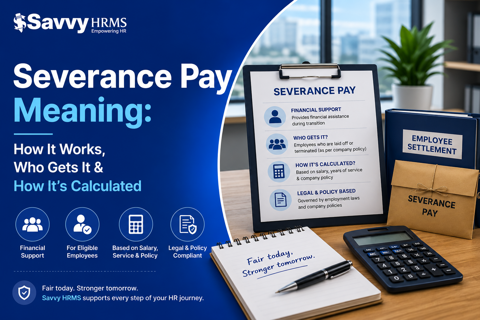
Layoffs and restructuring are never easy conversations to have. But once the decision is made, the real work for HR teams begins - and much of it centers around one question employees ask almost immediately: what am I entitled to?
Severance pay is often at the heart of that question, yet it remains one of the most misunderstood areas of Indian employment law. Is it mandatory? How is it calculated? Does it apply to every exit, or only specific situations? For HR professionals responsible for getting this right, the stakes are high - a miscalculated or delayed payout can lead to disputes, compliance violations, and lasting damage to employee trust.
This guide breaks down how severance pay works in India, who typically qualifies, and how HR teams can build a process that's both compliant and fair.
Why Severance Pay Deserves Its Own Process
Many organizations bundle severance pay into their broader full-and-final settlement process without giving it distinct attention. That's a risky approach, because severance pay isn't the same as gratuity, notice pay, or leave encashment - it has its own triggers, its own legal basis, and in many cases, its own calculation logic entirely separate from statutory dues.
Treating it as just another line item in the exit checklist increases the chance of errors. And because severance situations typically arise from layoffs, retrenchment, or business closures - already sensitive, high-visibility events - mistakes here tend to draw more scrutiny than a routine resignation would.
What Severance Pay Actually Covers
At its core, severance pay is compensation an employer provides when employment ends due to circumstances outside the employee's control - restructuring, redundancy, layoffs, or closure of operations. It functions as a financial bridge, giving employees some stability while they search for their next role.
A severance package can include more than just a lump-sum payout. Depending on company policy, it may combine compensation tied to years of service, notice period pay, unused leave payouts, gratuity where applicable, and occasionally extras like continued medical coverage or career transition support.
For a full breakdown of what severance pay includes, how it differs from gratuity and notice pay, and whether it's legally required in India, this guide on severance pay meaning, eligibility, and calculation is a helpful reference - it also walks through a worked calculation example that HR teams can use as a starting template.
Is Severance Pay Legally Required in India?
This is the question HR teams get asked most often, and the honest answer is: it depends. Indian labor law doesn't mandate severance pay for every type of separation. However, specific situations - particularly retrenchment, layoffs under certain conditions, and establishment closures - do carry statutory compensation obligations.
Outside of these legally defined scenarios, many companies choose to offer severance voluntarily, either as part of their employee welfare policy or to maintain a strong employer reputation. Whether mandatory or voluntary, the safest approach for HR teams is to have a documented policy that spells out exactly when severance applies and how it's calculated, rather than deciding case by case.
Who Typically Qualifies
Eligibility isn't automatic for every departing employee. In general, severance pay applies to situations such as:
Retrenchment, where a role becomes redundant due to restructuring
Business closure, where operations shut down entirely
Economic layoffs, where financial pressures force workforce reductions
Organizational restructuring, including mergers and acquisitions
Contractual or policy-based entitlement, where severance terms are written into the employment agreement
Mutual separation, where terms are negotiated as part of the exit agreement
On the other hand, employees who resign voluntarily, retire under normal circumstances, or are terminated for proven misconduct generally fall outside standard severance eligibility - though company policy can still extend benefits at the employer's discretion.
How HR Teams Typically Calculate It
There's no universal formula, which is exactly why so many disputes arise - different departments or managers may apply inconsistent logic without a clear policy to anchor decisions.
Most calculations weigh a combination of factors: the employee's last drawn salary, total years of service, the specific reason for separation, and any formula defined in the employment contract or internal HR policy. A common approach is a fixed number of days' or months' salary for every completed year of service, though the exact multiplier varies widely across industries and company size.
Because these calculations intersect with gratuity, leave encashment, notice pay, and tax deductions, it's easy for manual processes to produce inconsistent results - which is precisely where a structured, system-based approach helps.
Common Pitfalls HR Teams Should Avoid
Inconsistent application across cases. Without a documented formula, two employees in similar situations may receive different severance amounts, opening the door to fairness complaints.
Confusing severance with statutory dues. Gratuity and notice pay have their own legal requirements independent of severance. Conflating the two can lead to underpayment or non-compliance.
Delayed communication. Employees going through a layoff are already anxious. Vague or delayed information about their settlement timeline only adds to the stress and can damage trust in the process.
Ignoring documentation. In retrenchment or closure situations, labor authorities may require proof that compensation was calculated and paid correctly. Missing documentation creates unnecessary legal exposure.
Manual calculation errors. Spreadsheet-based processes are prone to mistakes, especially when multiple components - salary, tenure, leave balance, gratuity - all need to be factored in simultaneously.
Building a Severance Policy That Holds Up
A strong severance policy doesn't need to be complicated, but it does need to be clear and consistently applied. A few practical steps:
Define eligibility conditions explicitly. Spell out which types of separations qualify for severance and which don't.
Document the calculation formula. Whether it's based on tenure, salary, or a hybrid approach, write it down and apply it uniformly.
Separate severance from other settlement components. Keep gratuity, notice pay, and leave encashment calculations distinct, even if they're paid out together.
Set a payout timeline. Employees should know exactly when to expect their final compensation.
Review the policy periodically. Labor regulations and market practices evolve, so policies should be revisited at least annually.
The Role of HRMS Software in Severance Management
Given how many variables go into a severance calculation - salary history, tenure, leave balances, statutory requirements, and company-specific formulas - manual processing leaves too much room for error, especially when HR teams are managing multiple exits at once during a restructuring event.
A capable HRMS platform can pull together these data points automatically, applying a standardized formula consistently across every case. Beyond the calculation itself, good HR software also helps by centralizing employment records, generating audit-ready settlement reports, and keeping the entire separation workflow - from notice through final payout - compliant with applicable labor laws.
Savvy HRMS, for instance, brings severance calculations, full-and-final settlements, and compliance tracking into a single separation management workflow, which reduces the administrative burden on HR teams while minimizing the risk of calculation errors or missed deadlines during large-scale exits.
Communicating Severance Terms to Employees
Even a well-calculated severance package can feel unfair if it isn't communicated clearly. Employees going through a layoff or restructuring are often dealing with uncertainty and stress, and vague explanations about "final settlement being processed" only add to that anxiety. HR teams that walk employees through exactly what their package includes - severance compensation, notice pay, leave encashment, gratuity, and the expected payout date - tend to see far fewer disputes and follow-up escalations.
It also helps to put this information in writing, not just verbally. A simple settlement breakdown document, shared alongside the relieving letter, gives employees something concrete to reference and reduces the likelihood of misunderstandings later. This is a small step, but it consistently makes a big difference in how employees perceive the fairness of the process, regardless of how difficult the underlying circumstances were.
Severance Pay for Different Employee Categories
It's also worth noting that severance terms often aren't uniform across an organization. Senior leadership and key management personnel frequently have customized severance clauses built into their employment contracts, sometimes negotiated individually rather than following a standard company formula. Meanwhile, employees covered under collective bargaining agreements may have severance terms defined through union negotiations rather than company policy alone.
HR teams need to be aware of which category each departing employee falls into before applying a blanket formula. Applying a standard policy to an employee whose contract specifies different terms - or vice versa - can create compliance issues and employee relations problems that are entirely avoidable with proper categorization upfront.
Final Thoughts
Severance pay sits at a sensitive intersection of legal compliance, financial planning, and employee trust. Getting it right requires more than good intentions - it requires a documented policy, a consistent calculation approach, and enough process discipline to ensure every eligible employee is treated fairly and paid on time.
For HR teams navigating layoffs, restructuring, or closures, the organizations that handle severance well tend to come out the other side with less legal risk and a stronger reputation among both departing and remaining employees. Investing the time to build a clear, well-documented severance process now will save considerably more time - and far more goodwill - when the next difficult separation comes around.
0 件のコメント
この投稿にコメントしよう!
この投稿にはまだコメントがありません。
ぜひあなたの声を聞かせてください。